 Ultimate guide
NYC Skyline Views from the Water: 2026 Guide
Table of Contents
- Why the Water Beats Any Observation Deck
- The Best Sunset Views in New York Harbor
- Vantage Points: What You Can See from the Hudson and East Rivers
- Private Sailboat Charter NYC: What to Expect and Who It's For
- Harbor Cruise Photography Tips for Stunning Skyline Shots
- Budget vs. Luxury: Choosing Your Harbor Experience
- Weather, Accessibility, and Planning Your Trip
- Frequently Asked Questions
Last Updated: September 30, 2026
Why the Water Beats Any Observation Deck
Ask anyone who has done both: NYC skyline views from the water beat every observation deck in the city. An observation deck gives you height and a queue; a boat gives you the skyline at eye level, with nothing between your camera and the buildings.
The Best Sunset Views in New York Harbor
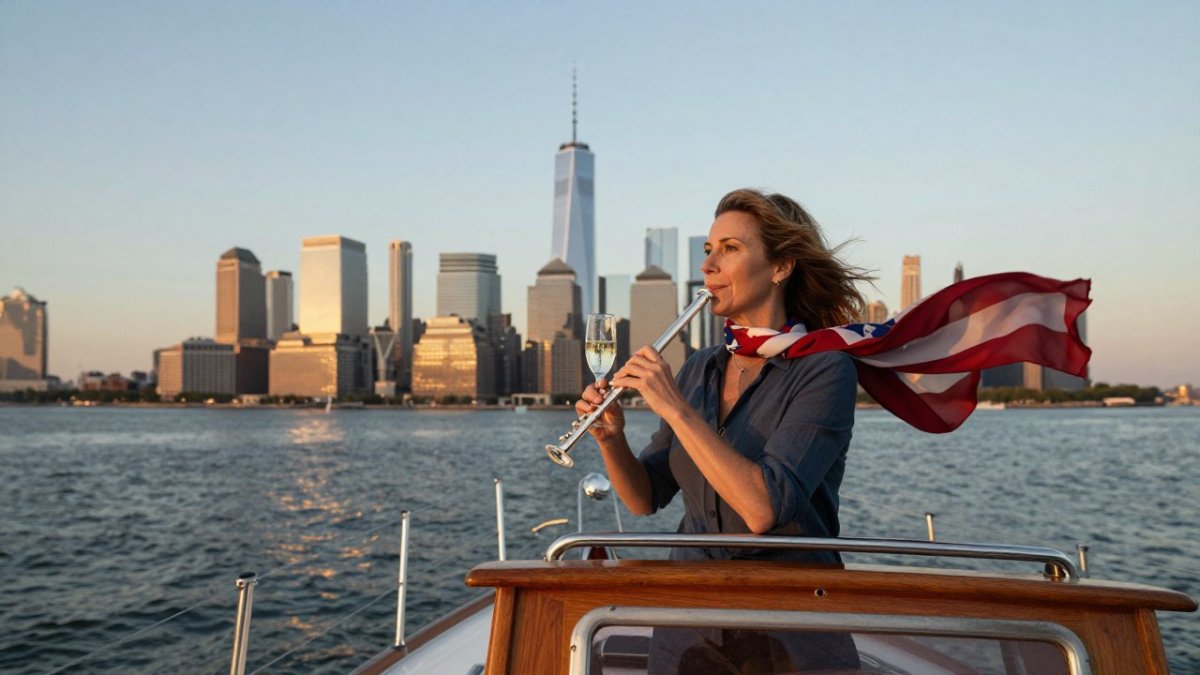
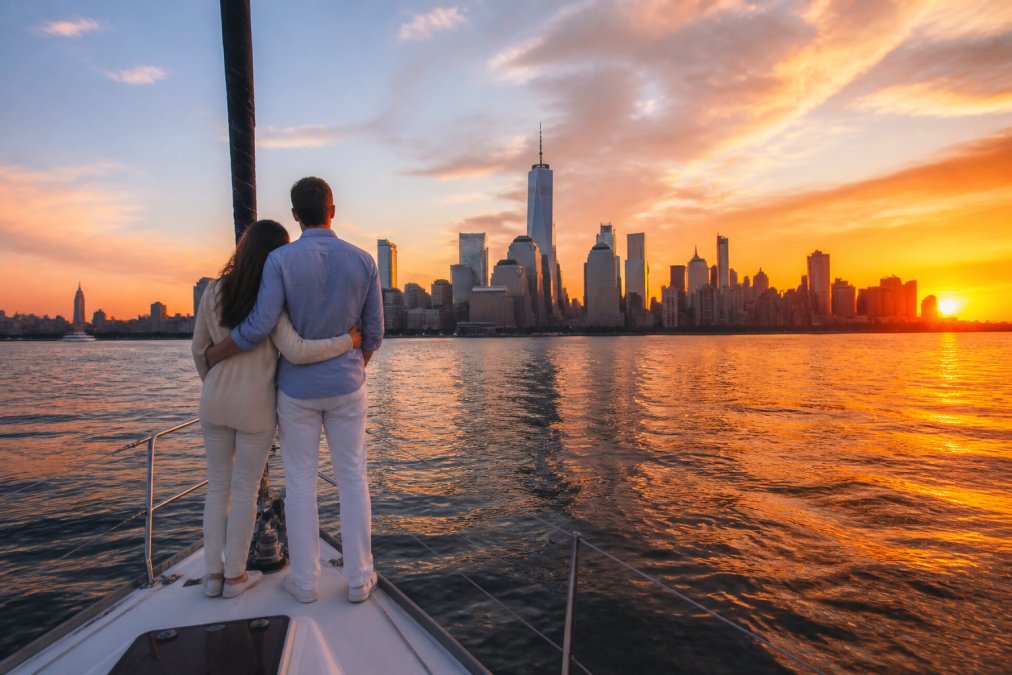
The best sunset views in New York harbor happen when you position yourself west of lower Manhattan, with the sun dropping behind the skyline and the buildings catching that last orange light. Timing shifts through the year.
Golden Hour Timing and Where to Position Yourself
Golden hour in New York runs roughly 30 to 45 minutes before sunset until about 20 minutes after. In summer that lands close to 8 p.m.; in winter it can start before 4 p.m. Plan around the season, not a fixed clock time.
Vantage Points: What You Can See from the Hudson and East Rivers
Every stretch of water frames the skyline differently, and the Hudson and East River are not interchangeable.
Lower Manhattan and the World Trade Center
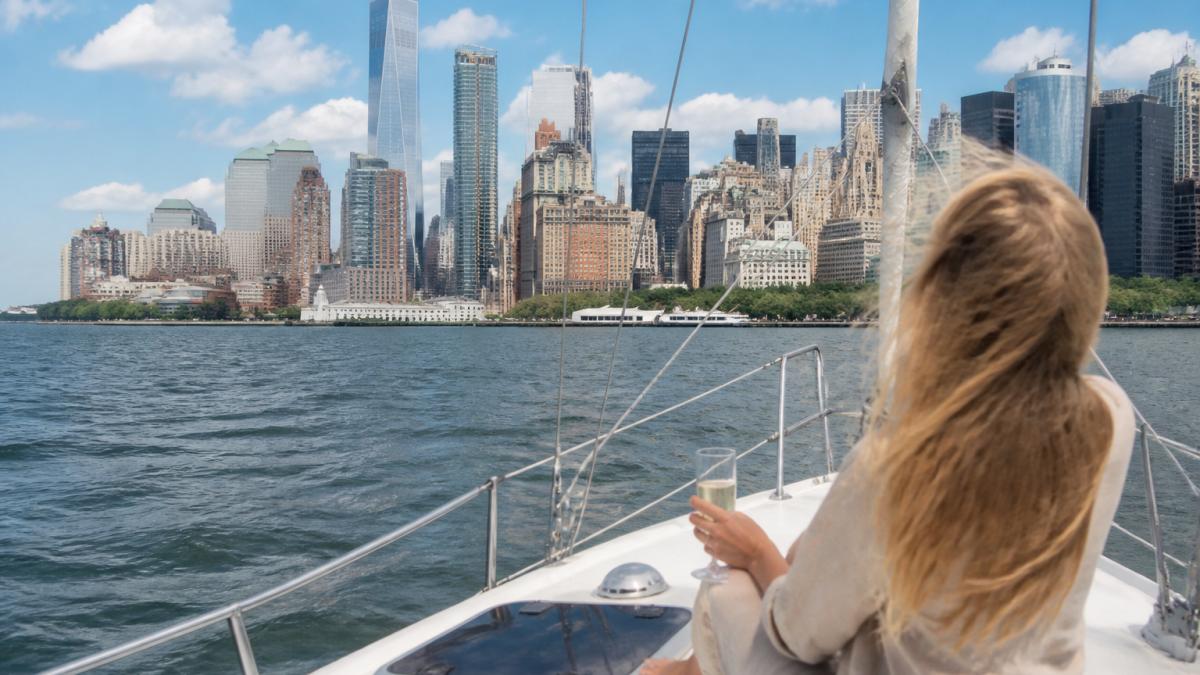
The Hudson River side delivers the postcard shot. From the water off lower Manhattan, One World Trade Center anchors the skyline with the financial district spread around it, the angle most people picture for NYC skyline views, and the one that photographs best at golden hour.
Brooklyn Bridge and the Harbor Entrance
The East River and harbor entrance offer what the Hudson cannot: the Brooklyn Bridge in the foreground with the skyline behind it, framed by ferries, tugs, and the bridge's stone arches.
Private Sailboat Charter NYC: What to Expect and Who It's For
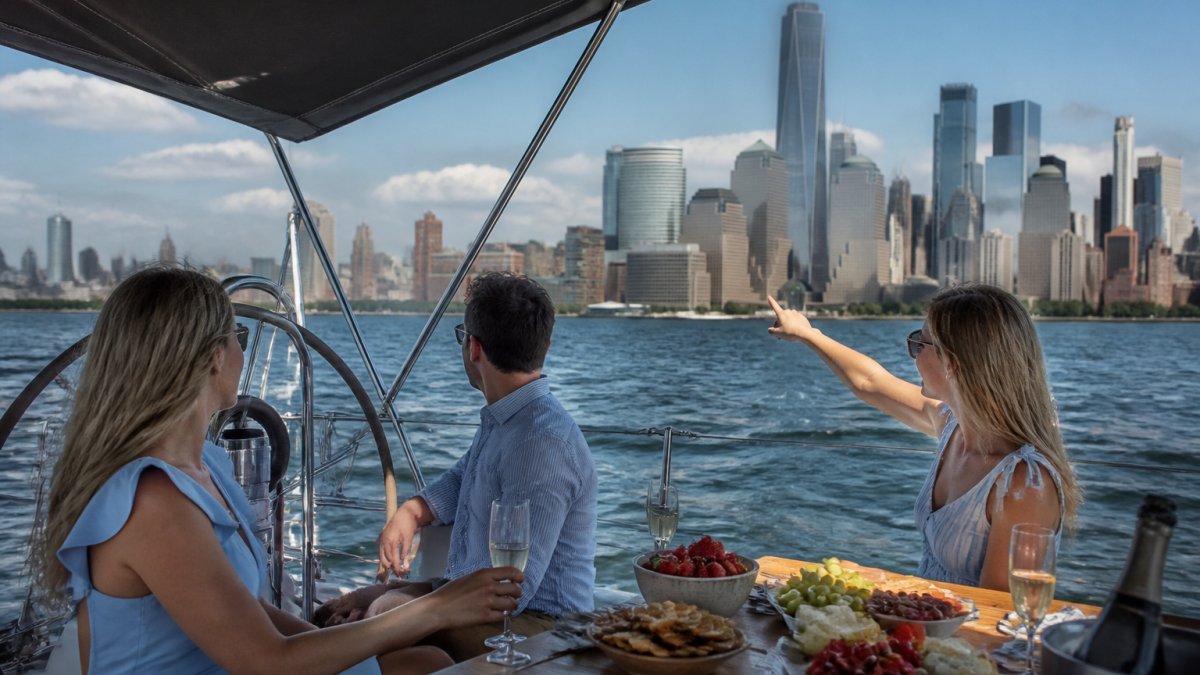
A private sailboat charter NYC is exactly what it sounds like: you book the boat, set the guest list, and the itinerary bends to what you want to see. No shared rail space, no loudspeaker narration, no schedule you did not choose.
- Couples planning a proposal or anniversary. Privacy lets you control the moment, timing, and setup without an audience.
- Small groups of friends or family. Six to eight people get a genuinely intimate experience instead of fighting for rail space.
- Locals marking a milestone. A birthday or promotion feels different on a private boat than in a crowded restaurant.
- Professionals hosting guests. A customizable journey impresses clients in a way a dinner reservation cannot.
Harbor Cruise Photography Tips for Stunning Skyline Shots
Harbor cruise photography tips usually focus on gear. The real difference-maker is understanding how a moving boat and low light interact, because that combination defeats most casual shooters.
Camera Settings for Night Photography on the Water
A few settings that work in practice:
- Aperture: f/2.8 to f/4 to gather light without losing sharpness
- ISO: 1600 to 3200 as a starting range, pushed higher if needed
- Shutter speed: 1/125s minimum for handheld shots on a moving deck
- Focus: manual, set to infinity, so the camera does not hunt in the dark
For the full skyline glow, shoot during the "blue hour" just after sunset, when the sky still holds color, the buildings light up, and the contrast between them peaks.
Budget vs. Luxury: Choosing Your Harbor Experience
Most guides split harbor options into "free ferry" and "expensive yacht" and leave it there. That framing hides the real decision, cost-to-experience ratio: how much unobstructed rail space, time on the water, and itinerary control you get per dollar.
The Four Real Tiers on the Water
| Tier | Typical Group Size | Time on Water | Itinerary Control | What You Are Really Paying For |
|---|---|---|---|---|
| Public commuter ferry | 100+ | 5-25 min per leg | None | A crossing, not a sightseeing trip |
| Large sightseeing cruise | 50-300 | 60-120 min | None | Narration and a set route |
| Small-group shared sail | 6-20 | 90-120 min | Minimal | A quieter deck and closer waterline |
| Private charter | Your group only | 2-6 hrs | Full | Position, timing, and privacy |
What Each Tier Actually Costs You
Public ferries are the cheapest way onto the water and hard to beat for a quick crossing between boroughs. What you give up is composition: you are on a schedule, the boat loads fast, and the rail fills with commuters. Treat a ferry as transportation with a view, not a skyline experience.
The Cost-to-Experience Ratio
A useful way to compare tiers is to divide what you pay by the minutes of unobstructed, well-positioned viewing you actually get:
- A ferry is cheap per minute but delivers almost no usable viewing time.
- A large cruise is moderate per minute but the minutes are shared and fixed.
- A private charter is the highest total cost but the lowest cost per usable minute, because every minute is yours and the captain can hold position.
Matching the Tier to the Occasion
- Just want to be on the water: a public ferry is fine and cheap.
- First-time visitor checking off landmarks: a large sightseeing cruise covers the most ground per dollar.
- Photographer chasing a specific shot: a private or small-group sail, because position and timing matter more than route.
- Proposal, anniversary, or milestone: private charter, full stop, you cannot control the moment on a shared deck.
The Bottom Line
The right tier depends on what you are optimizing for. Cost: the ferry wins. Coverage: the large cruise wins. A specific view, moment, or photograph: the private tier wins, and divided by your group size, the gap is usually smaller than the sticker price suggests.
Weather, Accessibility, and Planning Your Trip
Weather and accessibility are the two things most skyline guides skip, and the two that can wreck a trip. Here are the specifics you need before you book.
Reading the Marine Forecast Before You Go
Harbor conditions are not the same as the forecast on your phone. Wind, chop, and visibility on the water can differ meaningfully from conditions a few blocks inland. The National Weather Service publishes marine forecasts and small craft advisories for the harbor, check those the morning of your trip.
A few thresholds worth knowing:
- Small craft advisories are issued when sustained winds or seas are expected to reach levels that are hazardous for smaller vessels. If one is active, expect operators to reschedule or reroute.
- Afternoon wind typically builds through the day, which is why morning and early-evening departures often run calmer than midday.
- Summer thunderstorms can develop quickly in the afternoon; operators watch radar and will often hold at the dock rather than push through a cell.
- Fog and haze reduce visibility and flatten the skyline. On a hazy day, the far towers fade and the near ones lose contrast, a real problem for photography even when the water is calm.
What Happens If the Weather Turns
Reputable operators have a written weather policy, and you should read it before you pay. The common patterns:
- Operator cancels for safety: you are typically offered a reschedule or a refund. Ask which one, and ask how far in advance they make the call.
- You cancel for weather: policies vary widely. Some allow a free reschedule up to a set window; others do not. Get this in writing.
- Trip runs but conditions are marginal: the captain may shorten the route, stay in protected water, or skip a leg. Know in advance whether that affects your price.
Accessibility: What to Confirm Before Booking
Not every vessel is easy to board, and "accessible" means different things on different boats. Docks vary in height and slope, gangways vary in steepness, and some boats require stepping down into a cockpit or climbing a short ladder. If anyone in your group has mobility concerns, raise it at booking, not on the day.
Specifics worth confirming:
- Boarding method: ramp, gangway, or step-down. Ask which, and ask about the slope.
- Dock conditions: fixed versus floating docks behave differently with tide and can change the step height.
- Onboard layout: head (restroom) access, seating, and whether there is a stable place to sit if standing is difficult.
- Assistance: whether crew can physically assist boarding, and any weight or transfer limits on equipment.
Planning Basics That Save Headaches
- Book sunset slots early, especially in summer and around holidays.
- Check the marine forecast the morning of your trip, not the day before.
- Dress in layers; the water runs cooler than the shore, and wind adds to it.
- Bring motion sickness medication if you are prone to it, and take it before boarding, it works best as a preventive.
- Bring a small microfiber cloth; spray and humidity fog lenses fast.
- Confirm the meeting point and arrival time in advance; docks are not always obvious from the street.
Frequently Asked Questions
What is the best time of day for skyline photography from the water?
Golden hour, roughly one hour before sunset, gives you warm light on the buildings and softer shadows. Stay through blue hour (the 20-30 minutes after sunset) for skyline illumination and reflections on the water. Night photography after full dark works too, but you will need a fast lens or higher ISO. Check the sunset time for your date and arrive on the water at least 30 minutes early to get positioned.
How does a private sailboat charter differ from a public sightseeing cruise?
A private sailboat charter NYC experience means the boat is yours, no crowds, no set itinerary, and no waiting for 50 other tourists to board. You can customize timing for a proposal, choose your own vantage points, and bring your own food and drinks. Public cruises follow fixed routes and schedules. Private charters typically cost more but offer flexibility and intimacy that group tours cannot match.
Can you see the Statue of Liberty and the skyline on the same boat tour?
Yes. Most harbor routes pass the Statue of Liberty and then loop back toward lower Manhattan for skyline views. A private charter lets you linger at each spot as long as you want. The classic route goes south past the Battery, out to Liberty Island, then north along the Hudson or East River depending on conditions. Ask your captain to time the skyline portion for sunset.
What should I pack for a sunset harbor cruise in 2026?
Bring layers, even in summer, because it gets cooler on the water after sunset. A windproof jacket, comfortable shoes with grip, and sunglasses for the early part of the trip. For photography, pack a camera with manual settings, a lens cloth for spray, and a small tripod if your boat allows it. Sunscreen for daytime sails. Most private charters let you bring your own food and drinks, so check ahead.